
Interest Rates, First-Time Buyers & the Ghost of 2008: Is Homeownership Still Within Reach?
A little perspective on mortgage rates, affordability, and why today's housing market isn't quite what it used to be.
My daughter and her boyfriend moved into an apartment in Chandler earlier this year. They love it. They're both working, have good jobs, have managed to build decent savings, and are doing the things we generally tell young adults they're supposed to do.
But like so many first-time buyers, they're wondering whether they'll ever actually be able to afford a home, which I totally get.
Between the cost of groceries, gas, rent, and just about everything else, saving for a down payment while maintaining some financial security is no small accomplishment. Throw mortgage interest rates above 7% into the equation, and homeownership can start feeling more like a distant dream than an achievable goal.
But here's something worth considering: Are today's mortgage rates historically outrageous, or did we just get a little spoiled?
A Little Interest Rate Perspective
As of September 24, 2026, the average 30-year fixed mortgage rate was 7.03%, according to Freddie Mac. That certainly feels expensive compared with the sub-3% rates we saw during the pandemic. But those historically low rates were the exception, not the rule.
If we look back at mortgage rates over the last several decades, rates of 7%, 8%, and even double digits were once quite normal. In fact, mortgage rates climbed above 18% in the early 1980s.
Yes, 18%. Big yikes.
Of course, historical perspective doesn't make today's mortgage payment any easier to afford. Home prices, wages, insurance, property taxes, and the overall cost of living all play a role, and that is where today’s challenge really begins.
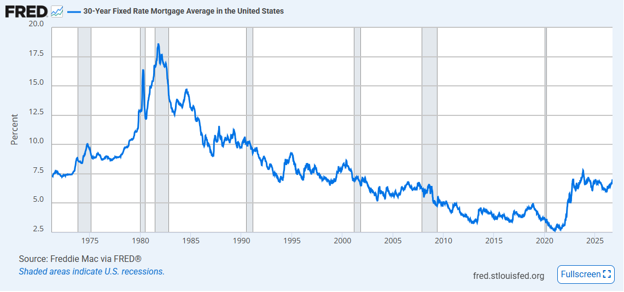
Source: Freddie Mac, 30-Year Fixed Rate Mortgage Average in the United States, via FRED (Federal Reserve Bank of St. Louis).
According to Federal Reserve Governor Michael Barr's September 23, 2026 remarks, approximately half of outstanding mortgages still have interest rates of 4% or lower.
It's Not Just the Mortgage Payment
Today's affordability problem goes well beyond interest rates.
Inflation continues to affect household budgets, and rising energy costs have added another layer of uncertainty. Global events have consequences that eventually find their way into our wallets, whether we're filling up the car or shopping for dinner.
For someone trying to save for their first home, these expenses matter day in and day out.
A buyer might have sufficient income to qualify for a mortgage on paper but still feel uncomfortable taking on the payment when everything else is becoming more expensive, and justifiably so.
The August 2026 Consumer Price Index reported annual inflation of 3.4%, with food prices up 2.7% and gasoline up 27.4% year over year.
Are We Looking at Another 2008?
I spent a significant portion of my career working in mortgage servicing, default management, loss mitigation, and compliance. So when people start comparing today's housing market to the financial crisis of 2008, I pay attention and maybe twitch a little bit.
There are some important differences.
Leading up to the 2008 crisis, mortgage lending included widespread problems involving poorly documented loans, risky mortgage products, inadequate underwriting, and borrowers being placed into loans they couldn't realistically sustain (Pick-A-Pay anyone?).
The aftermath brought significant regulatory reform.
The Dodd-Frank Act was enacted in 2010, and the Consumer Financial Protection Bureau (CFPB) was established in 2011. New mortgage regulations followed, including the Ability-to-Repay and Qualified Mortgage rules, which took effect in January 2014.
These requirements established stronger expectations for lenders to verify income, assets, employment, debts, and a borrower's ability to repay their mortgage.
In other words, the days of simply hoping a borrower could afford the loan were supposed to be over. That doesn't mean the mortgage industry is immune to risk or that another housing downturn is impossible.
But today's affordability challenges are not the same as the underwriting failures that contributed to the 2008 crisis.
What About the CFPB?
There's another development worth watching.
The Trump administration has pursued substantial reductions in the CFPB's operations as part of its broader approach to federal regulation. Supporters of reducing the agency's reach argue that excessive regulation can increase costs and restrict access to credit. Critics argue that weakening the agency reduces consumer protections and oversight.
For mortgage professionals, this raises an important question: What happens to the safeguards established after the financial crisis when federal enforcement capacity changes?
The underlying mortgage lending regulations do not automatically disappear because an agency is downsized. Lenders remain subject to applicable federal and state requirements, investor standards, and other oversight.
My hope is that the lessons learned from 2008 remain firmly embedded in how lenders evaluate risk and protect borrowers. Responsible lending should never go out of style.
The Other Problem: Nobody Wants to Give Up Their 3% Mortgage (Including Me)
Here's another piece of the affordability puzzle: Millions of homeowners purchased or refinanced their homes when mortgage rates were historically low. Now imagine having a mortgage at 2.75% and considering selling your home to purchase another one with a rate above 7%.
Even if you have substantial equity, that new monthly payment might make you reconsider moving, and that’s exactly what many homeowners are doing.
It's commonly referred to as the mortgage rate lock-in effect. Homeowners are reluctant to give up favorable financing, which can keep otherwise available homes off the market.
For first-time buyers, that creates another challenge: fewer existing homes to choose from.
The result is a complicated housing market where affordability and available inventory are closely connected.
So, What Should First-Time Buyers Actually Do?
This brings me back to my daughter and her boyfriend.
Will I tell them to buy a house simply because they have good jobs and some money saved? No, those are far from the only considerations when buying your first home.
Buying a home is a significant financial commitment, and there is risk involved. Home values fluctuate. Employment situations change. Unexpected expenses happen. And contrary to what some people might suggest, homeownership is not automatically the right financial decision for everyone at every stage of life.
But I also won’t advise them to abandon the idea because mortgage rates aren't 3% anymore. Instead, I'm going to encourage them to understand their options:
Determine a comfortable monthly payment, not simply the maximum amount a lender will approve.
Explore first-time buyer programs, down payment assistance, and potential builder incentives.
Compare new construction and resale properties.
Understand the complete cost of ownership, including taxes, insurance, HOA fees, maintenance, and mortgage insurance when applicable.
Keep emergency savings available after closing.
Consider whether the home will meet their needs for the next several years.
Monika's Tip
Buy based on the payment you can comfortably afford today, not the interest rate you hope to have tomorrow.
You don't need to predict the housing market to begin preparing for homeownership.
Sometimes the smartest first step isn't touring houses. It's having a conversation about your finances, your goals, and what buying a home would actually look like for you.
Whether you're ready in three months, three years, or you're still figuring it out, understanding your options puts you in a better position to make the decision that's right for you.
And if you're a first-time buyer in Chandler or the greater Phoenix area, I'd love to help you work through those questions.
No pressure. No crystal ball. Just good information and a realistic plan.

Stella, AKA Stelly Of The House Of Belly. Black and gray Cairn Terrier mix.
Stella's Two Cents
"Finding the perfect home takes patience. Finding the perfect spot on the couch? I'm already there."
— Stella, Move With Monika's Official Home Comfort Specialist and Belly Rub Connoisseur.